Prikazani su postovi s oznakom churches and cathedrals. Prikaži sve postove

17. 10. 2018.

UNESCO - Churches of Peace in Jawor and Świdnica, Poland


These are the largest timber-framed churches in Europe, built in the mid 17th century following the Peace of Westfalia treaties. They bear testimony to the quest for religious freedom and are a rare expression of Lutheran ideology in an idiom generally associated with the Catholic Church.
The imperial consent to build the churches was hard to come by, and eventually imposed strict conditions: they were to be built outside any town boundaries in strictly defined areas, only with wood and clay, could not feature a tower, and should be finished within a year. Still, they endured the test of time to this day - considered the masterpieces of skilled handicraft, they remain without peer in their technological complexity and size.
No wonder these churches are a WHS! Thank you Sebastian and Sabina for your additions to my UNESCO collection :)

07. 03. 2018.

Alta, Norway


The Northern Lights Cathedral - Alta Church. The building was constructed of concrete and wood with external cladding of titanium sheets. The central feature is the spiral with belfry. The interior contains art work by artist Peter Brandes.


The World Heritage Rock Art Centre - Alta Museum. Situated in Hjemmeluft, a small bay on Altafjord near the Arctic Circle, the museum is situated at the site of early settlement of Finnmark dating from around 11 000 years ago. 

23. 02. 2018.

UNESCO - Cathedral And Churches Of Echmiatsin And The Archaeological Site Of Zvartnots, Armenia


The cathedral and churches of Echmiatsin ( or Etchmiadzin ) and the archaeological remains at Zvartnots graphically illustrate the evolution and development of the Armenian central-domed cross-hall type of church, which exerted a profound influence on architectural and artistic development in the region. 

Etchmiadzin Cathedral is the mother church of the Armenian Apostolic Church, located in the city of Vagharshapat (Etchmiadzin). According to scholars it was the first cathedral built in ancient Armenia (early 4th century), and is considered the oldest cathedral in the world. The tour I was with included a visit to the museum of the cathedral, which has numerous items on display, including manuscripts and religious objects. Among its notable exhibits are the Holy Lance (Spear), relics belonging to Apostles of Jesus and John the Baptist, and a fragment of Noah's Ark. Many relic-containers offer no view of what is inside, so when I asked our guide 'how do we know what is inside?' she simply replied 'we don't' lol.

Zvartnots Cathedral (literally 'celestial angels cathedral') is a 7th-century centrally planned aisled tetraconch type Armenian cathedral built by the order of Catholicos Nerses the Builder from 643-652. Now in ruins, it is located at the edge of the city of Vagharshapat (Etchmiadzin). As ruins, there wasn't much to look at, but the atypical arches were still pretty cool :)

20. 02. 2018.

UNESCO- Historical Monuments Of Mtskheta, Georgia


The historic churches of Mtskheta, former capital of Georgia, are outstanding examples of medieval religious architecture in the Caucasus. They show the high artistic and cultural level attained by this ancient kingdom.
In the front is the Svetitstkhoveli Cathedral, an Eastern Orthodox cathedral, a masterpiece of the Early Middle Ages. The site itself dates back to the early fourth century, and is known as the burial site of Christ's mantle. In the back, the Jvari Monastery is a sixth century Georgian Orthodox monastery situated  on the rocky mountaintop at the confluence of the Mtkvari and Aragvi rivers; according to traditional accounts, on this location in the early 4th century Saint Nino, a female evangelist credited with converting King Mirian III of Iberia to Christianity, erected a large wooden cross on the site of a pagan temple. The cross was reportedly able to work miracles and therefore drew pilgrims from all over the Caucasus.

21. 01. 2018.

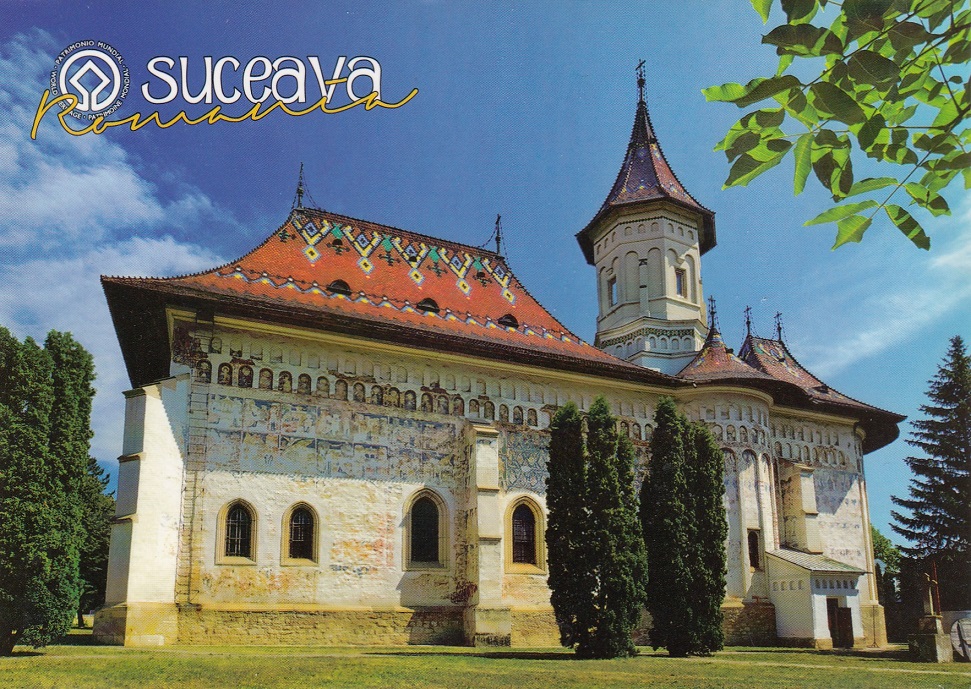
UNESCO - Churches Of Moldavia, Romania


Moldavia, or Țara Moldovei (in Romanian Latin alphabet), Цара Мѡлдовєй (in old Romanian Cyrillic alphabet)) is a historical region and former principality in Eastern Europe, corresponding to the territory between the Eastern Carpathians and the Dniester River. An initially independent and later autonomous state, it existed from the 14th century to 1859, when it united with Wallachia (Țara Românească) as the basis of the modern Romanian state.

There are eight Romanian Orthodox Churches located in Suceava County, northern Moldavia, that have been listed by UNESCO as a World Heritage Site since 1993. These churches, built from the late 15th century to the late 16th century, their external walls covered in fresco paintings, are masterpieces inspired by Byzantine art.

The ones depicted here are Saint John the New Monastery (Romanian: Mănăstirea Sfântul Ioan cel Nou) in Suceava, and the Church of the Elevation of the Holy Cross (Romanian: Biserica Înălțarea Sfintei Cruci) in Pătrăuți Commune. This was a great double swap with Viktor, mulţumesc!
 

17. 01. 2018.

Piazza Dei Miracoli, Pisa, Italy


The name Piazza dei Miracoli was coined by the Italian writer and poet Gabriele d'Annunzio who, in his novel Forse che sì forse che no (1910), described the square as the "prato dei Miracoli," or "meadow of miracles".
 It is better known as Piazza Del Duomo, and I have already written about it here. As I have been here while working on the ship here is a little reminder - as a tour escort I had access to the cathedral but not the tower. There was a tiny bit of free time but not enough to explore the rest of Pisa - and there was a lot to see, judging from what could be glimpsed from onboard a tourist train.
Grazie Chiara :) 

22. 03. 2016.

Pristina, Kosovo


Oh my has it been almost three weeks that I've posted here...and now I have a new pile to be scanned next month, before I have 'cleared out' the old batch. Well the story repeats and continues!

This card I have received a year ago, almost to the date. My second card from Kosovo, thanks to Ruedi who went there on a business trip, and was so diligent and sent like a million of postcards! Showing The Cathedral of Blessed Mother Teresa and The Sultan Mehmet Fatih Mosque, also known as the Imperial Mosque.

10. 02. 2016.

Iglesia San Miguel Arcángel In Ilobasco, El Salvador


After a long while, another postcard sent from El Salvador, thanks to William Guillermo :)
Ilobasco is a municipality in the Cabañas department of El Salvador, located 48 kilometers northeast of the capital San Salvador. This town is known country wide, and internationally, for its clay craftsmanship or pottery.
The snow-white colonial church depicted is Iglesia San Miguel Arcángel, whose construction begun sometime around 1880, and was built mainly thanks to donations and hard labour of local people. The church was damaged in the earthquake of 2001 but luckily no major damages were done to the facade. As the patron saint, San Miguel Arcángel is vigorously celebrated during the second half of September.

01. 10. 2015.

UNESCO - Villages With Fortified Churches In Transylvania, Romania


Recently I've received this awesome card with eight fortified churches in Transylvania, many thanks to Bernadett!
These fortified churches illustrate building styles from the 13th to the 16th century, and dominate the villages founded by the Transylvanian Saxons.

21. 09. 2015.

UNESCO - Archaeological Site Of Panamá Viejo And Historic District Of Panamá


Two great additions to my collection come from Panama - muchas gracias Blanca!
The whs site comprises two parts of Panama City, the old ruins and the historical district. Here we have cathedrals from both parts. 

Founded in 1519 by the conquistador Pedrarías Dávila, Panamá Viejo is the oldest European settlement on the Pacific coast of the Americas. It was laid out on a rectilinear grid and marks the transference from Europe of the idea of a planned town. Abandoned in the mid-17th century, it was replaced by a ‘new town’ (the ‘Historic District’), which has also preserved its original street plan, its architecture and an unusual mixture of Spanish, French and early American styles.

17th century was devastating for the original Panama City - it was attacked several times by pirates and indigenous people from Darién; in 1620 an earthquake damaged many buildings in the city; in 1644 the Great Fire destroyed 83 religious buildings, including the cathedral.

19. 09. 2015.

UNESCO - Episcopal City Of Albi, France


On the banks of the Tarn river in south-west France, the old city of Albi reflects the culmination of a medieval architectural and urban ensemble. Today the Old Bridge (Pont-Vieux), the Saint-Salvi quarter and its church are testimony to its initial development (10th -11th centuries). Following the Albigensian Crusade against the Cathar heretics (13th century) it became a powerful episcopal city. Built in a unique southern French Gothic style from local brick in characteristic red and orange colours, the lofty fortified Cathedral (late 13th century) dominates the city, demonstrating the power regained by the Roman Catholic clergy.
So much history here...thank you Sebastien for another card for my collection :)

31. 03. 2015.

UNESCO - Historic Town Of Ouro Preto, Brazil


Founded at the end of the 17th century, Ouro Preto (Black Gold) was the focal point of the gold rush and Brazil’s golden age in the 18th century. With the exhaustion of the gold mines in the 19th century, the city’s influence declined but many churches, bridges and fountains remain as a testimony to its past prosperity and the exceptional talent of the Baroque sculptor Aleijadinho.
First card showing the church of Nossa Senhora da Conceiçao (Immaculate Conception) and the second card the Esrada Real, which leads to the hill top - but I couldn't for the life of me figure out which church awaits there..!
Thanks to Karina (who also used the beautiful Ouro Preto stamp) and Gisely :)

05. 03. 2015.

Las Palmas Cathedral, Gran Canaria


This fantastic view is of the Cathedral of Santa Ana, the seat of the Diocese of the Canaries in the Roman Catholic Church. The structure was finished, and the first offices celebrated, on the eve of Corpus Christi, 1570, in the time of the fourteenth Bishop, Fr. Juan de Alzolares.
Love the colours, thank you Tina it is good to hear you had a great time there :D
 

26. 01. 2015.

UNESCO - Rock-Hewn Churches Of Ivanovo, Bulgaria


In the valley of the Roussenski Lom River, in north east Bulgaria, a complex of rock-hewn churches, chapels, monasteries and cells developed in the vicinity of the village of Ivanovo. This is where the first hermits had dug out their cells and churches during the 12th century. The 14th-century murals testify to the exceptional skill of the artists belonging to the Tarnovo School of painting.
One of those places you rarely come across on sites about travelling, even though they look utterly fascinating. Lilia did so much for my Bulgarian section of Unesco sites :)

02. 01. 2015.

UNESCO - Brasilia, Brazil


Brasilia, a capital created ex nihilo in the centre of the country in 1956, was a landmark in the history of town planning. Urban planner Lucio Costa and architect Oscar Niemeyer intended that every element – from the layout of the residential and administrative districts (often compared to the shape of a bird in flight) to the symmetry of the buildings themselves – should be in harmony with the city’s overall design. The official buildings, in particular, are innovative and imaginative.

A while ago I have received a postcard showing the Supreme Federal Court, and last year I've swapped/tagged for views of the Cathedral of Brasília. I really appreciate everyone using different stamps!

12. 10. 2014.

St. George's Cathedral, Georgetown, Guyana


Jo took an awesome trip this year covering many countries and even continents - she rounded it up by sending cards from the final three destinations, the 'three Guianas' on the southamerican continent. Starting from the westernmost Guyana, this postcard was written in the jungle and it must have had quite a ride (also visible from the runny letters :))
St. George's is an Anglican cathedral in Georgetown, the capital of Guyana, and is one of the tallest wooden churches in the world, at a height of 43.5 metres (143 ft). It features typical elements of Gothic architecture- flying buttresses, traceried windows, clerestory, pointed arches, "black and white" framing of Elizabethan times. All this put it on the unesco tentative list :) Thanks Jo!
 

24. 09. 2014.

UNESCO - Wooden Churches Of Maramureș, Romania


Another great surprise - well for a surprise group in vacation RR ;) Many thanks to Violeta for this splendid view, and look, autumn colours sneaked in again..!
In the Maramureș region of northern Transylvania there is a group of almost one hundred Orthodox churches, and occasionally Greek-Catholic ones, of different architectural solutions from different periods and areas. Eight were listed by the UNESCO as World Heritage Sites in 1999, for their religious architecture and timber construction traditions.
One of them is this jewel in Bârsana - Church of the Presentation of the Virgin in the Temple. Here are a few interesting facts: it was built in 1720; of thick beams of oak on a foundation of massive blocks of stone; the name bârsan means a shepherd who keeps sheep with thick long wool; it was used for monastic purposes until 1791, when the monastery was abolished.
I have little hope to collect all eight churches heh.
 

17. 09. 2014.

UNESCO - Petäjävesi Old Church, Finland


I have re-discovered a whole another folder with older postcards to include in my blog (I seem to be making it a habit), including this wonderful snow view of the Petäjävesi Church - situated in central Finland, it was built of logs between 1763 and 1765.  This Lutheran country church is a typical example of an architectural tradition that is unique to eastern Scandinavia. It combines the Renaissance conception of a centrally planned church with older forms deriving from Gothic groin vaults.
Thanks goes to Sini who also used a matching stamp :))